Sweating & condensation · Jacksonville Beach
Sub-Zero Condensation & Sweating Between the Doors in Jacksonville Beach
For Sub-Zero repair in Jacksonville Beach, call (904) 650-0561 or book online — seven days a week, 8 a.m. to 8 p.m.
Reviewed and current as of June 13, 2026.
First, which is it
Exterior Sweat vs. Interior Frost
Before anything else, find out where the moisture is. The same complaint — "my Sub-Zero is wet" — splits into two completely different repairs depending on whether it's outside or inside the box.
Exterior sweat: a humidity or seal problem
Water beading on the door faces, on the cabinet, or in the gap between two doors is condensation. It works exactly like a cold drink on a Jacksonville Beach porch — warm, moisture-laden air touches a cold surface and gives up its water. On a refrigerator that means humid air is reaching the cold edge of the cabinet, almost always because a tired gasket is leaking it past the seal, or because the room itself is extremely humid. This is the cheaper lane, and the door gasket page covers the seal fix in detail.
Interior frost: a defrost or airflow problem
White frost or ice building up inside the compartment — on the back wall, around the food, or stacking on the freezer evaporator — is not condensation at all. It points at the automatic defrost system: a failed defrost heater or thermostat, or an airflow fault, letting moisture freeze where it should be cleared. That's a freezer-side diagnosis, walked through on the freezer repair page. Outside is sweat; inside is frost.
Why the beach sweats
What Makes a Sub-Zero Condense in 32250
Coastal humidity is the engine behind this complaint, and it attacks the one part that's supposed to keep humid air out: the door seal.
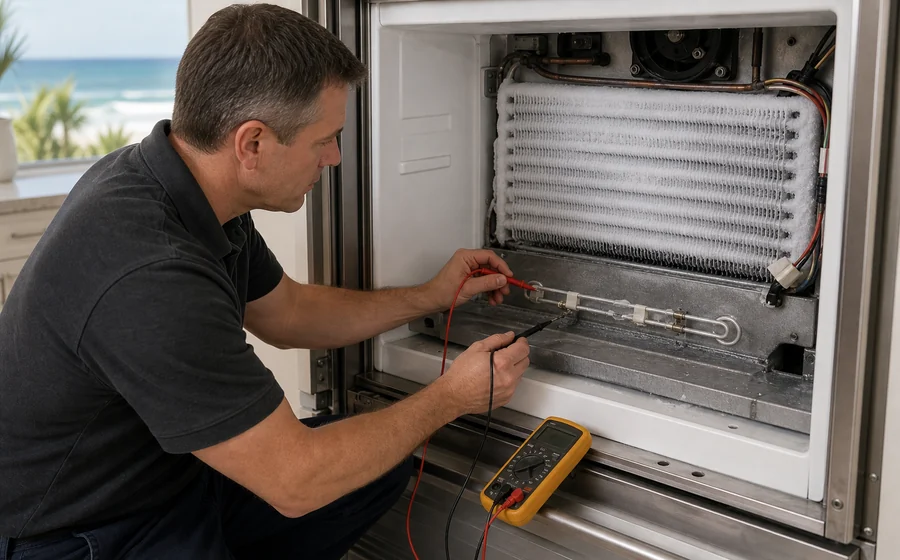
Year-round humidity is the trigger
The heavy, moist air that defines a Jax Beach summer is the same air that condenses on the cold cabinet the moment it gets past the seal. Higher the humidity, more the dew that forms on any cold edge — so a marginal gasket that would be fine in a dry climate sweats visibly here.
Salt and humidity harden the gasket
The magnetic gasket is a flexible vinyl strip that has to bend and grip the cabinet on every close. Constant salt air and coastal moisture work that vinyl until it stiffens, chalks, and stops sealing — in three to four seasons within a few blocks of the surf, against well over a decade inland. A hardened seal lets humid air seep across the cold edge around the clock, and the sweat appears right at the leak.
A racked or misaligned door
A door that has sagged or racked over the years — common on the heavy 48-inch built-in doors in the oceanfront rebuilds — won't pull flush against the cabinet, so even a good gasket can't seal evenly. The result is the same: a thin gap where humid air leaks in and condenses. Realigning the door is sometimes the whole fix, and sometimes paired with a new seal.
Garages and summer kitchens run damp
The older 600-series boxes in the cottages near the pier and any unit in a garage or covered summer kitchen breathe far more moisture than a conditioned interior. Those units sweat first and worst, and the extra humidity ages their seals faster too.
Work it in order
How to Diagnose the Sweat Yourself
Run this from cheapest cause to most involved before you book. Often the first two steps tell you everything.
- Find the moisture. Outside the doors or in the gap = condensation (seal or humidity). Inside, as frost or ice = a defrost fault. This one decision sets the whole path.
- Run the dollar-bill test. Close the door on a bill and pull. No drag means the seal isn't gripping there. Walk all four sides — corners and the hinge side fail first.
- Feel the gasket. Supple and springy is healthy; hard, chalky, or cracked has stopped flexing. At the beach, a stiff seal is usually salt and humidity, not age alone.
- Check the door's swing and fit. Does it pull flush and even all the way around, or does one corner stand proud? A racked door leaves a gap a good gasket still can't close.
- Note the room. Garage, summer kitchen, or a humid pantry will sweat a unit that's actually fine. Tell us where it lives — placement can be the whole answer, then book a slot.
Plain numbers
What Each Cause Typically Runs
Match the cause to the range we'd quote. Planning figures — the on-site written quote is exact and depends on the model, door size, and what the diagnosis finds.
| Cause | The tell | Typical range |
|---|---|---|
| Hardened / leaking door gasket | Dollar-bill test fails; stiff, chalky vinyl | $550–$1,100 |
| 48-inch / dual-door gasket | Larger seal and labor on BI-48 and PRO doors | $900–$1,100 |
| Door misalignment / racking | Door stands proud at a corner; uneven seal contact | $550–$1,100 |
| High ambient humidity, seal good | Garage / summer-kitchen install; gasket passes the test | Placement advice — often no part |
| Interior frost from a defrost fault | Ice inside the box, not sweat outside | $550–$1,100 |
Catching a leaking seal early protects the condenser and compressor from years of overrun — a humid leak makes the unit run hard, the same way a torn gasket shows up on the fridge repair page as an excessive-run code.
From the route
Diagnostic Case Notes
Educational diagnostic scenarios, not customer reviews.
Ocean Forest, BI-42SD, sweat in the gap between the doors. The owner had been wiping it daily through a humid June. The dollar-bill test slid free along the hinge side of the freezer door, and the vinyl was chalky and stiff. A new gasket, relaxed and seated flat, stopped the sweat; the ticket sat in the gasket lane. We confirmed the door pulled flush so the new seal had a fair chance.
South Jax Beach, 600-series in a garage conversion. Heavy cabinet sweat that turned out not to be a failed part at all — the unit lived in an unconditioned garage in peak summer humidity, and the gasket passed the bill test cleanly. The fix was placement and ventilation guidance, not a repair. Reading the moisture and the room before reaching for parts saved an unnecessary gasket job.
Condensation questions
Sweating-Cabinet Questions From the Beach
Why is my Sub-Zero sweating between the doors or on the cabinet?
Exterior sweat on a Sub-Zero is condensation — warm, humid beach air hitting a cold surface and dropping its moisture, exactly like a glass of iced tea on a Jax Beach porch. Most of the time the trigger is a door gasket that has hardened and stopped sealing, letting humid air leak across the cold edge. Very high ambient humidity in a garage or summer kitchen can do it on its own, and a misaligned door that doesn't pull flush will too. The fix follows the cause: a seal test first, then the gasket or the alignment.
How do I tell exterior sweat from interior frost?
Where you find the moisture tells you which problem you have. Water beading on the outside of the doors, on the cabinet face, or in the gap between two doors is condensation — a gasket or humidity issue, the cheaper lane. White frost or ice building up inside the compartment, on the back wall, or around the food is a different animal: it points at a defrost-system or airflow fault that needs the freezer side diagnosed. Outside is sweat; inside is frost, and they lead to different repairs.
How do I test whether my door gasket is the cause?
Run the dollar-bill test. Close the door on a bill and pull it out. If it slides free with no drag, that spot of the seal isn't gripping and is leaking humid air against the cold cabinet — which is what makes the sweat. Walk the bill around all four sides; gaskets usually fail at a corner or along the hinge side first. A seal that feels hard, chalky, or cracked instead of supple has stopped flexing, and at the beach that's salt and humidity at work.
Why does this happen so much more in Jacksonville Beach?
Year-round coastal humidity is the whole story. The same moist air that makes a Jax Beach summer feel heavy is the air leaking across a tired seal and condensing on the cold cabinet, and it also hardens the magnetic vinyl gaskets far faster than inland — three to four seasons near the surf against a decade-plus elsewhere. Units in garages, butler's pantries, and covered summer kitchens breathe even damper air, so they sweat first and worst.
What does it cost to fix a sweating Sub-Zero?
If the cause is the gasket, replacement typically runs $550 to $1,100, with the salt-hardened seals on 48-inch built-in doors toward the higher end because both the part and the labor are larger. A door realignment can be folded into that. If the sweat is purely high ambient humidity with a good seal, there may be nothing to replace — just placement and ventilation advice. If the moisture turns out to be interior frost from a defrost fault, that is a separate freezer-side repair. Every job gets a written quote first.
Can I just wipe it off, or does condensation cause damage?
Wiping it off treats the puddle, not the leak. A seal that lets humid air in sweats around the clock, and that constant moisture corrodes door hinges and trim, can grow mildew in the gap, and means the unit is also running harder to fight the warm air it is admitting. The condensation is the visible symptom of a seal that is quietly aging the whole unit. Catch it early and it is a cheap gasket; ignore it and it compounds.