Freezers · Jacksonville Beach
Sub-Zero Freezer Repair in Jacksonville Beach
For Sub-Zero repair in Jacksonville Beach, call (904) 650-0561 or book online — seven days a week, 8 a.m. to 8 p.m.
Reviewed and current as of June 13, 2026.
The cold-side method
How We Read a Warm or Frosting Freezer
A freezer fails in one of two directions — it ices over or it drifts warm — and the two point at opposite parts. We measure first so the truck carries the right fix on the first trip.
- Put a real thermometer in the box. The display reads the sensor, not the air. We confirm the actual cabinet temperature against the 0°F target before deciding anything.
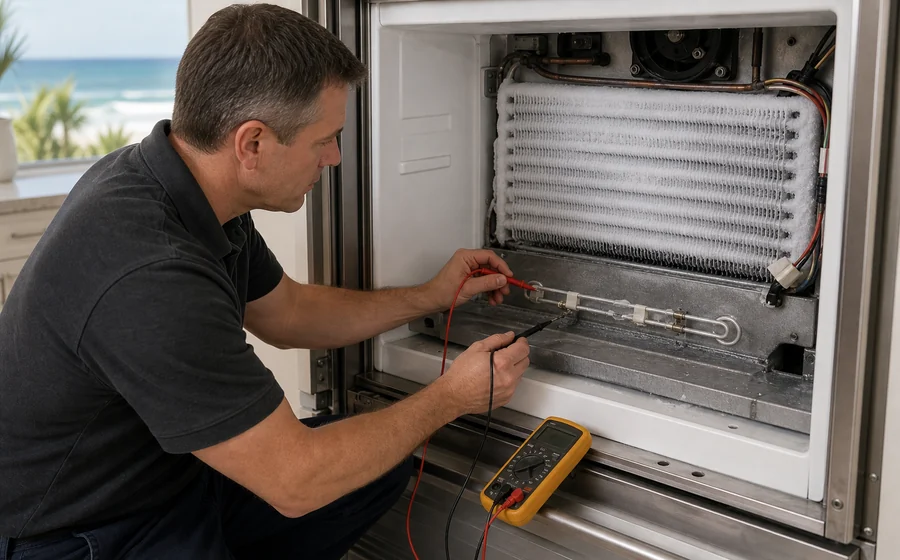
- Look at the evaporator. A solid sheet of frost on the back panel says the defrost cycle stalled; a bare, dry coil with a warm box points at airflow or refrigerant instead.
- Test the defrost chain. Heater element, defrost thermostat, and the board relay that fires them — one of those three is behind most frost-over calls in 32250.
- Spin and read the fan. A slow or seized evaporator fan starves the freezer of cold air even when everything else works, and the symptom mimics a sealed-system problem.
- Prove refrigerant last. Only after airflow and electrical clear do we pull pressures. A frost line dying off after the first few inches of coil is the classic leak signature.
You see the number before any panel comes off, and if a defrost repair and a sealed-system repair are both on the table, you get both prices and the honest call. The repair cost guide lays out how each lane is built.
Plain numbers
Freezer Symptom, First Check, Cost Lane
Match your symptom, see what gets tested first, and know the lane before we knock. These are planning figures — the on-site quote is the exact one.
| Symptom | First check on-site | Cost lane |
|---|---|---|
| Frost sheeting the back wall | Defrost heater, thermostat, board relay | $350–$750 |
| Cold but soft ice cream | Thermistor drift, evaporator fan speed | $250–$700 |
| Warm after a power outage | Board power-up, error history (EC40) | $550–$1,100 |
| Ice in the bottom of the drawer | Defrost drain clog, drain heater | $250–$550 |
| Freezer not freezing at all | Sealed-system pressure check | $1,500–$3,000 |
Local conditions
Why Beach Freezers Ice Over Faster
The freezer is the part of the machine that fights humidity head-on, and Jacksonville Beach hands it more moisture than most kitchens ever see.
Humid air and a tired gasket
Year-round humidity at the beach means every door opening pulls damp air across the coil, and a door gasket stiffened by salt lets even more sneak in around the edges. The defrost cycle has to clear that extra moisture daily; once the heater weakens, the coil ices ahead of the cycle and airflow dies. We see this most on units a few blocks off the water where gaskets age in three to four seasons.
Outage surges hit the freezer board too
The same control board manages both compartments, so a restoration surge after one of Northeast Florida's 100-plus storm days a year can leave a freezer warm even when the fridge looks fine. On BI-series built-ins the brownout lock kills the panel outright; on 600-series boxes it more often scrambles the defrost timing.
Cottage alcoves trap the heat the freezer rejects
The mid-century cottages behind the pier and around South Beach Park often boxed the unit into a tight alcove during the remodel. With barely an inch of clearance, the heat both compartments shed has nowhere to go, the compressor runs longer, and the freezer is usually the first side to complain. It is a weekly find on this stretch of sand.
If the fridge side is the real problem, the refrigerator repair page runs the matching triage. Finding meltwater on the floor instead of just warm food? The leaking-water guide covers a clogged defrost drain, and we cover every street in the 32250 coverage area.
The parts bin
Parts We Replace on the Cold Side
Freezer tickets concentrate in the defrost chain and the air movers. These are the parts behind most 32250 freezer calls, and almost all of them are contained, single-visit repairs when the part is on the truck.
| Part | Symptom it causes | Why it fails in 32250 |
|---|---|---|
| Defrost heater element | Frost sheeting the rear panel, airflow choked | Cycles harder against humid coastal air pulled past the gasket |
| Defrost thermostat | Cycle never terminates or never fires; coil ices | Salt-laden moisture loads the evaporator faster than inland |
| Evaporator fan motor | Cold but soft ice cream; box drifts to 12-18°F | Wears under the longer runtimes alcove heat forces |
| Drain heater / clearing the drain | Ice puddle in the bottom of the drawer | Hard-water mineral and frost plug the defrost drain line |
| Door gasket | Edge frost, condensation, daily over-icing | Salt air stiffens the seal in three to four seasons |
The benchmark stays 0°F after a 24-hour stabilization window; a freezer parked at 12 to 18°F is failing even when it still feels cold to the hand. If the drain is the real story, the leaking-water page traces the clog end to end.
Two failures, opposite fixes
Telling a Defrost Failure from a Sealed-System Failure
A warm freezer has two very different root causes, and they sit at opposite ends of the price sheet. The evaporator coil tells the story before any meter comes out.
| What you see | Likely root cause | Cost lane |
|---|---|---|
| Solid sheet of frost over the whole coil | Defrost heater, thermostat, or board relay quit | $350–$750 |
| Frost only on the first few inches of coil | Low refrigerant — a sealed-system leak | $1,500–$3,000 |
| Bare, dry coil with a warm box | Evaporator fan or airflow blockage | $250–$700 |
| Coil iced and water pooling below | Clogged defrost drain plus a defrost fault | $250–$550 |
We confirm the read with pressures only after airflow and the defrost chain clear, so nobody pays sealed-system money for a burned-out heater. If the warm side turns out to be the fresh-food compartment instead, the fridge-side service page carries the matching diagnosis, and a seven-day booking slot is a tap away.
Case Note: South Jax Beach, the Frosted 642
Educational diagnostic scenario — a composite of common Jax Beach calls, not a customer review
A 600-series 642 in a renovated South Jax Beach cottage: freezer drifting to 14°F, a wall of frost an inch thick on the rear panel, the fridge side holding 38°F just fine. The defrost heater read open on the meter — it had simply burned out after years of fighting humid coastal air, and the coil had iced solid behind it.
New heater, a defrost thermostat verified in spec, and a manual cycle to clear the existing ice. By the next evening the box was back at 0°F. The ticket sat in the mid-hundreds. The takeaway: a frosting freezer over a healthy fridge is a defrost problem nine times out of ten, not a dying compressor.
Good questions
Freezer Questions From the Beach
My freezer still feels cold but the ice cream is soft — is that normal?
No, and it is the early warning most people ignore. A Sub-Zero freezer should hold 0°F, and ice cream goes soft somewhere north of 10°F. A box that feels cold to your hand can be running 12 to 18 degrees warm. Usually it is a defrost heater that quit or an evaporator fan losing speed, both caught fast and both far cheaper than waiting until everything thaws.
There is frost building on the back wall of my freezer — what causes that?
Frost climbing the rear panel almost always means the automatic defrost cycle stopped firing. Sub-Zero runs a heater on a timed cycle to clear the evaporator; when the heater, defrost thermostat, or board control fails, ice sheets over the coil and airflow chokes. On older 600-series boxes it is often the heater element, on BI freezer drawers more often the thermostat or a board-side relay.
How long should I wait after a defrost repair before the freezer is back to 0°F?
Give it a full 24 hours before you judge it. Sub-Zero specifically calls out a 24-hour stabilization window after any cooling repair, and a freezer that iced over needs time to clear residual moisture and pull the cabinet back down. We leave it running, confirm the cycle fires correctly, and tell you the temperature to expect on the display by the next evening.
Can salt air kill a freezer the same way it kills the fridge side?
It works on the same parts — the condenser is shared by both compartments on most built-ins, so corroded fins starve the whole machine of heat rejection and the freezer suffers right alongside the fridge. What is unique to the cold side is icing: humid coastal air pulled in past a salt-hardened door gasket adds moisture the defrost cycle has to fight every single day.
Is a freezer-only failure on a side-by-side worth fixing on a 20-year-old unit?
Often yes. A defrost heater, thermostat, or evaporator fan on a 632 or 642 runs a few hundred dollars, and the rest of the machine may have a decade left. The number changes if the freezer-side sealed system is leaking — that lane runs $1,500 to $3,000 — but even then a built-in cabinet match usually makes the repair the smarter spend. We give you both numbers.
How do I manually defrost a Sub-Zero freezer that has iced solid?
You can buy time by emptying the freezer, switching the unit off, and letting the ice melt with towels down and the drawer open — usually several hours. It clears the symptom but not the cause, because a healthy defrost cycle should have prevented the buildup. If frost returns within a week or two, the heater, thermostat, or board relay is the real fix; a manual thaw just confirms the diagnosis.
Why does my BI freezer drawer leave an ice puddle in the bottom?
That puddle is a clogged defrost drain. Meltwater from each defrost cycle should run out a small drain line and evaporate near the compressor; when hard-water mineral or refrozen frost plugs the line, the water backs up and sheets across the drawer floor. We clear the line, check the drain heater that keeps it open, and confirm the next cycle drains clean — a $250-to-$550 lane on most BI units.
Is 5°F warmer than 0°F enough to ruin frozen food at the beach?
It is enough to start. Frozen food degrades slowly once a freezer climbs past 0°F, and texture and ice-cream consistency suffer first around 10°F. The bigger beach concern is repeated partial thaw-and-refreeze cycles from a failing defrost system, which is harder on food than a single steady offset. If the box is holding 5°F and climbing, treat it as an early failure, not a quirk.