Error codes · Jacksonville Beach
Sub-Zero Error Codes Explained for Jacksonville Beach Owners
For Sub-Zero repair in Jacksonville Beach, call (904) 650-0561 or book online — seven days a week, 8 a.m. to 8 p.m.
Reviewed and current as of June 13, 2026.
Read it right
What a Sub-Zero Code Is Actually Telling You
A code is the start of the visit, not the quote. It tells us which side struggled and which board generation is talking. The cause still has to be proven with airflow, door-load, electrical, and frost-pattern evidence.
The BI-series built-ins in oceanfront rebuilds use EC numbers. Older 500 and 600-series units in beach cottages may show a service light, double dashes, or a Vacuum Condenser message instead. Model and serial matter because a 632 and a BI-48SD do not report trouble in the same language.
Whatever the display says, the stored board history matters more than the one warning currently visible. History tells us whether this is a slow salt-air choke, a fan output fault, or a post-storm electrical event. The BI-series repair page goes deeper on the board itself.
The reference
Sub-Zero Code Reference: What Each One Means
The real codes and fault states we see around 32250, defined plainly, with the first move. Planning guidance — the on-site diagnosis is exact.
- EC50
- Fresh-food side ran longer than expected. First move: expose the condenser intake, confirm the fan can move air, and look for beach grit on the coil face.
- EC40
- Freezer-side run history. On a dual-system PRO 48, this is the useful one because it keeps the refrigerator side out of the first round of testing.
- "Vacuum Condenser" light (600-series, 1998–2002 boards)
- Older 600-series wording for a condenser-airflow warning. First move: clean and verify the air path, then note the model because board availability varies by generation.
- Service light flashing
- A broad attention lamp. It can be stored sensor history, a run-time event, or a board input that needs metering. First move: photograph it before resetting.
A cleaning visit sits in the $250–$550 range. Refrigerant evidence moves the job into the $1,500–$3,000 range. The repair cost guide lines each of these up against a planning range.
Cause → evidence → cost
What Drives an Excessive-Run Code, and What It Costs
This is the beach order: breathe first, doors second, electronics third, refrigerant last. A code without that evidence is not enough to quote a sealed-system repair.
| Likely cause | Evidence on the visit | Typical range |
|---|---|---|
| Salt-loaded condenser | White grit on fins, hot discharge line, weak pull through grille | $250–$550 |
| Fan or board-output fault | Fan command present but blade movement low, or output missing | $250–$550 |
| Beach-hardened gasket | Loose paper test, stiff magnet strip, condensation at seal | $550–$1,100 |
| Bad cabinet temperature input | Thermistor reading does not match actual box temperature | $550–$1,100 |
| Leak or restriction | Clean airflow, but frost pattern stops near the evaporator inlet | $1,500–$3,000 |
The gasket matters more at the beach than owners expect. A hardened seal lets humid air into the box all day, which stretches run time and can look like a mechanical cooling fault. The door gasket page covers that seal test in detail.
Why here, why now
Why These Codes Cluster at the Beach
The same few warnings show up on the sandbar because the operating conditions are harsher than the manual's clean indoor baseline.
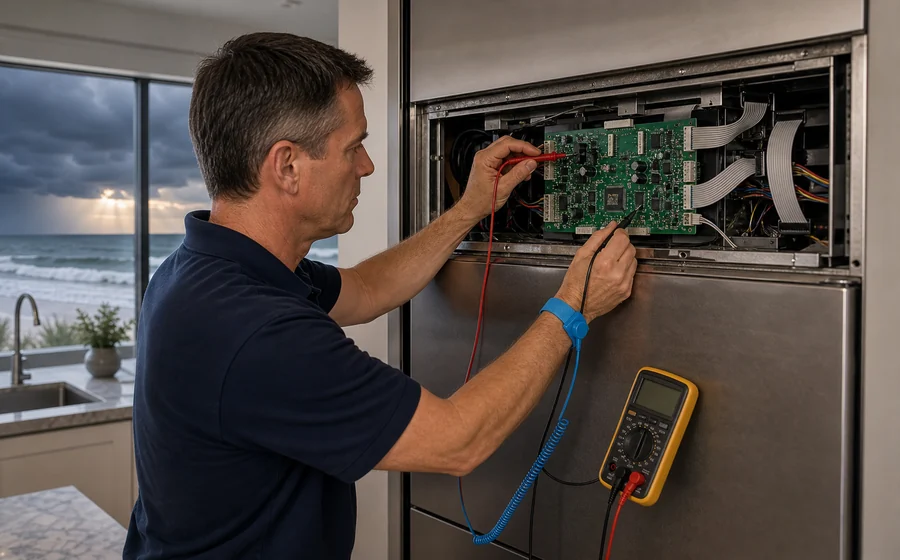
EC50 and the salt-fog coil
EC50 is common in 32250 because salt fog settles on the condenser fins and the refrigerator side has to work harder to dump heat. A coil can look acceptable from the room and still be insulated on the backside. Cleaning intervals need to tighten the closer the kitchen sits to the surf.
EC40 and the dual-system PRO 48
Bigger oceanfront rebuilds often have PRO 48 units. The freezer side has its own compressor and sealed circuit, so an EC40-only history lets us keep the refrigerator side closed while testing the freezer half. The PRO 48 page covers per-side diagnosis.
The service light and the restoration surge
Beach kitchens see frequent storm flickers. The risky moment is utility restoration, when voltage comes back hard and can corrupt board state, fail a fan output, or leave the panel dark. If your display acted up on a stormy night, the warm-after-outage page explains the brownout lock and the fix.
Before you call
What to Do the Moment a Code Appears
- Write down exactly what the display shows. EC50, EC40, a flashing service light, a Vacuum Condenser warning, dashes, or nothing at all — each points somewhere different, and "it's acting up" doesn't.
- For EC50 or EC40, start with airflow. Open the grille, brush gently, vacuum the coil face, and make sure trim is not blocking the intake.
- Note any recent power event. A storm, a flicker, or a breaker trip the night before reframes a flashing light or a dead panel from mystery to surge damage.
- Grab the model and serial. The data plate sits just inside the upper-left fresh-food compartment on built-ins. It tells us which code set applies and which part revision to bring.
- Reset clears the symptom, not the cause. If the code returns after a proper coil cleaning, stop resetting and book a slot — seven days a week. A returning code is the board telling you the restriction is still there.
From the route
Diagnostic Case Notes
Educational diagnostic scenarios, not customer reviews.
Ocean Forest, BI-36U. A recurring EC50 the owner had cleared three times after stormy weeks. The lower grille looked normal from the kitchen, but the coil face behind it was packed with beach grit. After the intake was opened, cleaned, and the fan draw verified, run time dropped back into range. No compressor quote belonged on that ticket.
South Jax Beach, PRO 48. EC40 logging on the freezer side only. The refrigerator half was stable, so the visit stayed on the freezer circuit. Airflow was clean, but board output to the condenser fan failed under call. Repairing that control-side fault restored normal freezer run cycles without opening the fresh-food system.
Code questions
Error-Code Questions From Jax Beach Owners
What does an EC code mean on my Sub-Zero?
On these built-ins, an EC warning means one side ran too long to hold temperature. EC50 points to the refrigerator side, EC40 to the freezer side. At Jacksonville Beach the first suspects are a salt-loaded condenser, blocked grille airflow, a tired condenser fan, or a gasket leaking humid beach air. It starts the diagnosis; it does not name a dead compressor.
Whats the difference between EC50 and EC40?
EC50 is fresh-food side history. EC40 is freezer side history. On a single-system unit the distinction is mostly a clue about which compartment lost ground first. On a PRO 48, each side has its own system, so the code keeps the healthy half closed while we test the side that actually logged the warning.
My Sub-Zero shows EC50 — can I fix it myself?
If the temperatures are stable, clean the condenser first. Open the grille, brush gently, and vacuum the coil face. East of 3rd Street, a coil can look clean from the room but still be insulated by salt grit. If EC50 returns after a real cleaning, stop resetting it and schedule a board-history read.
I cleared the code and it came back — why?
A reset only deletes the message from view. If the coil still cannot shed heat, the fan is weak, or the gasket is still leaking, the board watches another long run and stores the warning again. A returning code is useful information: the load is still there.
What is the "Vacuum Condenser" light on my older Sub-Zero?
That is older 600-series language. Instead of EC50 or EC40, the board uses plain words to ask for condenser attention. We still read the model and serial before interpreting it, because a 600-series board, BI board, and PRO 48 board do not speak the same diagnostic dialect.
The service light is flashing or the panel shows dashes — is that an error code?
It is a fault state, but not the same EC warning. A flashing service light can be sensor history; double dashes on a 600-series often point to EEPROM memory; a blank BI panel after a storm can be a brownout lock. Photograph the display before cycling power.
When is an excessive-run code actually a sealed-system repair?
After the cheap evidence is cleared. If airflow is clean, fan output is right, doors seal, sensors read correctly, and the evaporator only frosts near the inlet, then the call moves toward refrigerant work. The code alone never justifies opening the sealed circuit.