After the storm · Jacksonville Beach
Sub-Zero Warm or Dark After a Power Outage in Jacksonville Beach
For Sub-Zero repair in Jacksonville Beach, call (904) 650-0561 or book online — seven days a week, 8 a.m. to 8 p.m.
Reviewed and current as of June 13, 2026.
The real mechanism
Why It's the Surge, Not the Outage
Owners blame the blackout, but a Sub-Zero rides out a dead grid fine — it just sits there cold. The damage happens in the half-second the power comes back.
Northeast Florida logs more than 100 thunderstorm days a year, and the state leads the country in cloud-to-ground lightning. On a sandbar with few obstructions, the beach catches its full share. When the grid drops and restores — sometimes flickering several times before it holds — the restoration spike can run 50 to 100 percent over normal line voltage. That is the moment a BI-series control board gets hurt.
The brownout lock
The classic post-storm failure is the "brownout lock": the cabinet interior lights still work, the unit clearly has power, but the control panel is blank or unresponsive and nothing cools. The board's logic has latched into a fault state it can't clear on its own. Sometimes a clean power cycle resets it; when the surge actually damaged the board, it won't, and the panel stays dark. Our BI-series page breaks down that board and the swap.
The fried condenser-fan triac
The other common surge casualty is subtler. The triac that switches the condenser fan on the board can fail while the rest of the panel looks normal — so the display reads fine, the compressor runs, but the fan never spins, the unit can't reject heat, and it slowly warms. This one masquerades as a dirty-condenser complaint, which is why we meter the triac output rather than trust the panel.
Do this first
What to Check Before You Call
Five minutes of checking can turn a service call into a free reset — or tell us exactly what to bring. Run this in order; it starts with the cheapest possible cause.
- Check the breaker first. Storms trip panels all over the beach. If the unit is totally dark, the breaker is the first stop, not the board. Reset it once and watch.
- Do the five-minute power cycle. Kill power at the breaker for a full five minutes, then restore it — once. If the panel comes back and the unit starts cooling, it was a transient lock and you are done. Don't repeat it; cycling stresses the start components.
- Confirm the circuit. A Sub-Zero should sit on a dedicated, properly grounded circuit. A shared or marginal circuit makes surge damage and nuisance trips more likely.
- Note exactly what the panel does. Blank with lights on, lit but not cooling, a code, dashes — each points somewhere different. A blank panel with lights on after a storm is the brownout-lock signature.
- Give it 24 hours. If the unit powered back up, it needs a full day to pull back to 38°F fridge and 0°F freezer. Still climbing past that window means it's a repair, not recovery — then book a slot.
Plain numbers
Reset vs. Board Work — What Each Runs
Match the symptom to the likely cause and the range we'd quote. The reset is free to try; the board work is planning guidance, and every job gets a written number before a part goes in.
| Symptom | Likely cause | Typical range |
|---|---|---|
| Panel back to life after a 5-minute cycle | Transient brownout lock, no damage | Reset — no part |
| Panel blank, lights still on | Surge-damaged / brownout-locked board | $550–$1,100 |
| Display reads fine but unit warms, fan silent | Failed condenser-fan triac on the board | $550–$1,100 |
| Recurs every storm season | No surge protection on the circuit | Surge protection ~$900–$1,200 |
| Warm with a code showing, not a dead panel | Excessive-run / cooling fault — see error codes | $250–$3,000 |
If the panel shows an EC code rather than going dark, start on the error-codes page; if it's warming with no display drama, the not-cooling triage walks it from first check to cost lane.
Prevent the next one
Surge Protection Is the Real Fix
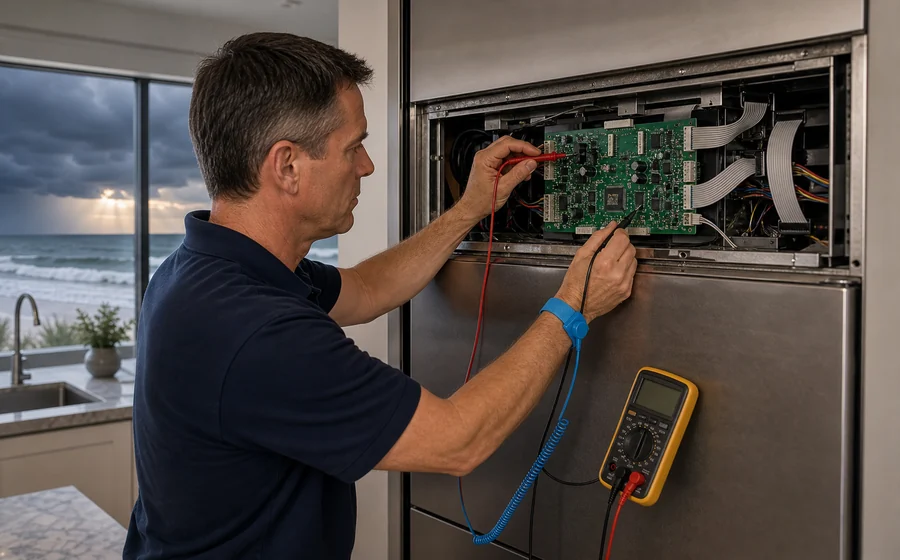
Replacing a killed board fixes today's problem; whole-home surge protection at the panel keeps it from happening every storm season. A properly rated surge device clamps the restoration spike before it ever reaches the board, and it protects every piece of electronics in the house — not just the Sub-Zero. Installed cost is roughly $900 to $1,200, and against a board that runs $550 to $1,100 every time lightning works the grid, the math is simple on a coast that sees 100-plus storm days a year.
If your unit lives in a 1940s-to-70s cottage with an older panel, or in an oceanfront rebuild where salt has worked the board's connections, the case is stronger still. We'll tell you honestly whether your install warrants it — and an electrician handles the panel device while we handle the appliance.
From the route
Diagnostic Case Notes
Educational diagnostic scenarios, not customer reviews.
South Jax Beach, BI-42SD, the morning after a line of storms. Cabinet lights on, panel dead, fridge warming. A single five-minute breaker cycle did nothing — the board had taken the hit, not just locked. Reading it on instruments confirmed a failed board; the replacement landed in the board lane, and we flagged the lack of surge protection as the reason it would recur.
Ocean Forest, BI-36U, "it cools but it's getting warm." The panel read normally, which sent the owner chasing a dirty condenser. The coil was clean; the condenser-fan triac on the board had failed in a surge, so the fan never ran. Metering the triac output named it in minutes — a panel that looks fine is not proof the board is fine.
Post-outage questions
Power-Outage Questions From the Beach
My Sub-Zero is warm and the panel is dark after a storm — what happened?
Almost certainly the restoration surge, not the outage. When power slams back after a Jax Beach storm it can spike 50 to 100 percent over normal line voltage, and BI-series control boards are notorious for going into a 'brownout lock' afterward: the cabinet lights work, the unit has power, but the panel is blank and unresponsive and nothing cools. Sometimes the same surge takes out the condenser-fan triac on the board instead. The first step is a clean power cycle; if that doesn't bring the panel back, it is a board diagnosis.
How do I reset a Sub-Zero after a power outage?
Kill power at the breaker for a full five minutes, then restore it — one time. That clears a transient lock on a board that wasn't actually damaged, which is why we always try it before condemning anything. Repeated on-off cycling stresses the compressor start components and can do real harm, so do it once and wait. Give the unit 24 hours to pull back toward 38°F fridge and 0°F freezer before you decide it failed; recovery and failure look identical for the first day.
Why does Jacksonville Beach get so many surge-killed Sub-Zero boards?
Northeast Florida logs 100-plus thunderstorm days a year and the state leads the country in cloud-to-ground lightning, so the beach takes more power events than almost anywhere. It is rarely the outage that kills the board — it is the restoration spike when the grid comes back, plus nearby strikes coupling into the line. Add salt-air corrosion on board connections and the older electrical panels in the cottage stock, and the BI-series boards out here see more surge damage than inland units ever do.
Is it the board, or just a reset away? How can I tell?
The five-minute power cycle is the tell. If the panel comes back to life and the unit starts cooling, it was a transient lock and you are done. If the panel stays blank with the lights still on, or it lights up but won't command a cooling cycle, the board took surge damage and needs to be read on instruments. A burning smell, a tripping breaker, or scorch marks change the answer to unplug-and-call immediately.
What does it cost to fix a surge-damaged Sub-Zero board?
A control board replacement typically lands in the $550 to $1,100 range, and board availability moves the number — some 600-series boards are rebuilt-only now, which can stretch the timeline. A simple reset costs nothing. If the surge only took the condenser-fan triac, that is sometimes a board-section repair rather than a full swap. Every job gets a written quote before any part goes in, applied against the diagnostic visit.
How do I stop this from happening again?
Whole-home surge protection at the panel is the real fix — it clamps the restoration spike before it reaches the board, and it protects every electronic appliance, not just the Sub-Zero. A dedicated, properly grounded circuit for the unit helps too. Given 100-plus storm days a year out here, surge protection is one of the few upgrades that genuinely pays for itself, since one killed board costs more than the protection.