Sealed systems · Jacksonville Beach
Sub-Zero Sealed-System & Compressor Repair in Jacksonville Beach
For Sub-Zero repair in Jacksonville Beach, call (904) 650-0561 or book online — seven days a week, 8 a.m. to 8 p.m.
Reviewed and current as of June 13, 2026.
First principles
What "Sealed System" Means on a Sub-Zero
Everything else on the unit — fans, boards, gaskets, ice makers — bolts on and comes off. The sealed system is the part that's brazed shut, and opening it is what separates real Sub-Zero work from parts-swapping.
The circuit is simple to name and hard to service: a compressor pumps refrigerant, the condenser sheds the heat, a metering device drops the pressure, and the evaporator absorbs heat from inside the box. A filter-drier keeps the refrigerant clean and dry. On most Sub-Zero built-ins each compartment carries its own sealed system, which is why a freezer can fail stone-cold dead while the fridge above it keeps holding 38°F — and why a PRO 48 has to be diagnosed one side at a time.
When any of those brazed components fails or springs a leak, the fix isn't a screwdriver job. It's recovery, brazing with a heat shield, pulling a vacuum deep enough to boil off every trace of moisture, and recharging to the exact factory weight. Do it carelessly and you trap moisture that destroys the new compressor inside a season. That's the whole reason this lane costs what it does.
Proof first
How We Prove a Leak Before Quoting It
Sealed-system money is the easiest money for a lazy shop to take — just say "it's the compressor." We don't get to say that until the evidence does. Here's the order on every Jax Beach call.
- Read the frost pattern. A circuit short on charge frosts only the first 4 to 8 inches of the evaporator and runs warm past that. A full, even frost pattern means the refrigerant is there — and the problem is somewhere else.
- Verify temps and airflow. We rule out a dirty condenser, a dead evaporator fan, and a drifted thermistor first. Most "needs a compressor" calls are actually one of these — a mid-hundreds fix, not a four-figure one.
- Take pressures at the ports. Gauges on the schrader fittings tell us whether the charge is low, the compressor is pumping, and where the restriction sits. Numbers, not guesses.
- Find the leak. Electronic leak detection and a visual on the brazed joints and the corrosion-prone condenser pinpoint where refrigerant is escaping before we open anything.
- Written quote, then the work. Only after the evidence lines up do you get a number — and an honest replace recommendation if the cabinet or compressor doesn't justify the repair.
That sequence is exactly why a unit needing a $300 fan never leaves with a $2,500 compressor quote. The not-cooling triage page walks the same logic from the symptom side.
Local conditions
Why the Beach Is Hard on Sealed Systems
Sealed-system failures aren't random. In 32250 they cluster around three very local forces, and knowing which one is at work tells us a lot before the gauges go on.
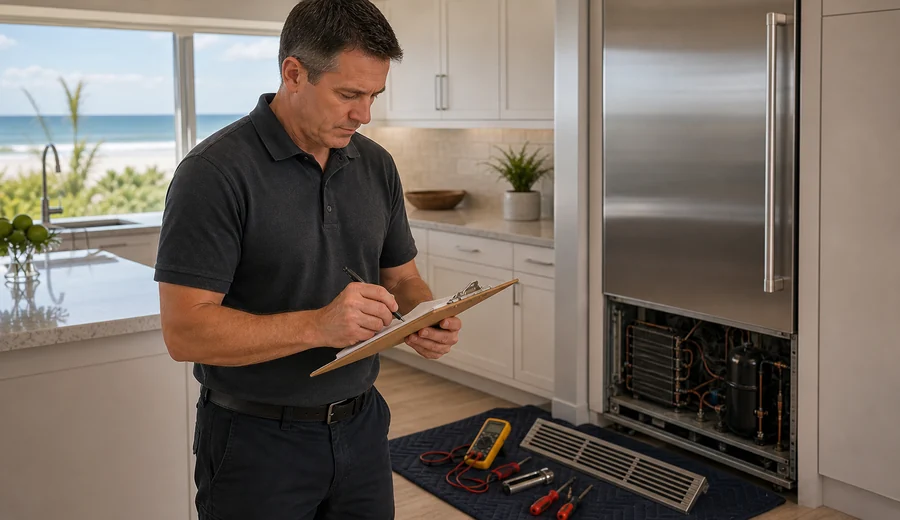
Salt-corroded condensers overwork the compressor
Oceanfront units along 1st Street South and the blocks east of 3rd Street breathe salt fog year-round. Corroded condenser fins shed heat poorly, so the compressor runs longer and hotter to reach the same set point. Years of that overwork is what fatigues compressors and the brazed joints around them — the single most common path to sealed-system work near the surf.
Cottage alcoves trap heat
The mid-century cottages around South Beach Park and the pier often boxed a full-size Sub-Zero into an alcove with barely an inch of clearance. Starved ventilation means the same heat-rejection problem from the inside: long compressor runs, high head pressure, early failure. We check airflow before we condemn a compressor in a tight install.
The classics are simply old
The 500 and 600-series units still humming in renovated cottage kitchens are 20 to 35 years into service. At that age a slow evaporator leak or a tired compressor is a normal wear item, not a defect — and on a sound cabinet, the sealed-system repair almost always beats a five-figure replacement.
Plain numbers
What Sealed-System Work Costs in Jax Beach
These are planning ranges; the written quote on-site is exact and follows the diagnosis. Every figure already assumes a new dryer, a proper vacuum, and a weighed recharge — never a top-off.
| Repair | Typical range | What's involved |
|---|---|---|
| Refrigerant leak find & repair | $1,500–$3,000 | Locate, braze, replace dryer, evacuate, weighed recharge. |
| Evaporator replacement | $1,500–$3,000 | Common on classics; alcove access adds disassembly time. |
| Compressor replacement | $1,000–$2,000+ | Recovery, brazing, recharge, and a real leak check after. |
| Condenser / dryer service | $550–$1,100 | When corrosion or a saturated drier is the root cause. |
Compare these against the roughly $10,000–$14,000 to replace a built-in and refit the cabinetry — the repair cost guide lays the full comparison out line by line.
Repair vs replace
When the Sealed System Says "Repair," and When It Says "Replace"
A sealed-system quote is the moment the repair-or-replace question gets real, so we answer it honestly. On a structurally sound cabinet — and most Jax Beach built-ins are — a documented sealed-system repair around $2,500 against a roughly $14,000 replacement isn't a close call. That gap is the entire argument for repair, and it's why we've turned five-figure "just replace it" verdicts into four-figure fixes on units with twenty good years left.
Replacement earns the recommendation when the math actually flips: a compressor failure stacked on a corroded condenser and a leaking evaporator on the same aging circuit, or a cabinet that's been compromised. When that's the picture, we say so plainly rather than sell you a repair that won't hold. Either way you get the numbers and the reasoning, not a sales pitch — the same standard described on the about page.
Case Note: Sealed-System Save in a Cottage Kitchen
Educational diagnostic scenario — a composite of common Jax Beach calls, not a customer review
A 1990s 600-series in a renovated cottage off 4th Avenue South: fridge drifting warm, freezer fine, and another shop had quoted a full replacement at five figures. The frost pattern told the story — it died off four inches into the fridge-side evaporator. Pressures confirmed a slow refrigerant leak, not a dead unit.
We located the leak at a corroded joint, brazed it, replaced the drier, pulled a deep vacuum, and recharged by weight. The cabinet was solid and the compressor tested strong. Total landed in the sealed-system lane — a fraction of the replacement quote — and the unit went back to holding 38°F. The lesson: prove the charge before you condemn the box.
Good questions
Sealed-System Questions From the Beach
What exactly is the "sealed system" on a Sub-Zero?
It's the refrigeration circuit itself — compressor, condenser, evaporator, dryer, and the copper lines carrying refrigerant between them, all brazed closed at the factory. When a shop says 'sealed-system work,' they mean opening that circuit: recovering refrigerant, brazing in a part, pulling a vacuum, and recharging by weight. On most Sub-Zero built-ins each compartment has its own sealed system, which is why a freezer can fail while the fridge stays cold.
How do you know it is a sealed-system leak and not a cheaper part?
We prove it before we ever quote it. The signature of a refrigerant leak is a frost pattern that covers only the first few inches of the evaporator and then dies off — the circuit is short on charge. We confirm with low-side pressure readings at the schrader ports and, where needed, an electronic leak detector. A warm box with a full frost pattern and good pressures is almost never sealed-system; it's a fan, a thermistor, or a board, and those are mid-hundreds, not thousands.
Is a sealed-system repair worth it on a 25- or 30-year-old Sub-Zero?
Often, yes — and that surprises people. A documented sealed-system repair on a classic 600-series runs around $1,500 to $3,000, while replacing a built-in lands near $10,000 to $14,000 once you add cabinetry rework to fit a new box into the old cutout. If the cabinet is sound and the rest of the unit is healthy, the repair routinely buys another decade. We give you the honest replace-instead number when the math genuinely flips.
Does salt air at the beach cause sealed-system failures?
Indirectly, and constantly. Salt fog corrodes the condenser fins on oceanfront units east of 3rd Street, the compressor then runs hotter and longer to shed the same heat, and years of that overwork is what fatigues compressors and stresses brazed joints. We see more compressor and sealed-system work within a few blocks of the surf than anywhere inland in 32250. Keeping the condenser clean is the cheapest sealed-system insurance there is.
How long does sealed-system work take, and can you do it in my kitchen?
Plan on a half to a full day. Recovery, brazing, a deep vacuum to remove moisture, and a weighed recharge can't be rushed — moisture left in the circuit will wreck a new compressor. We do most of it on-site with proper recovery equipment and heat shields, never an open flame near cabinetry. Tight cottage-alcove installs around the pier add disassembly time, which we'll flag in the written quote.
Do you replace the dryer and recharge by weight, or just top it off?
Always the dryer, always a weighed charge — no top-offs. Any time the circuit is opened, the filter-drier gets replaced because it's now saturated, and the system is evacuated and recharged to the factory weight, not 'until it feels cold.' Topping off a leaking system is how a $300 'fix' becomes a dead compressor in six months. If we open it, we do it once and we do it right.