Wine storage · Jacksonville Beach
Sub-Zero Wine Cooler Repair in Jacksonville Beach
For Sub-Zero repair in Jacksonville Beach, call (904) 650-0561 or book online — seven days a week, 8 a.m. to 8 p.m.
Reviewed and current as of June 13, 2026.
What goes wrong
How Wine Units Fail — and Why It Matters Fast
A wine cooler does not just need to be cold — it needs to be steady. Good storage lives in a 45-to-55°F band, and the failures that pull a zone off that band are specific and very fixable.
The most common is dual-zone thermistor drift: each zone runs its own temperature sensor, and as one ages its reading wanders, so the controller chases the wrong setpoint. You see one zone holding perfectly while the other creeps warm or cold. The cabinet is sound — the sensor is feeding bad numbers, and a swap puts it right.
Close behind are evaporator icing from a stuck sensor or defrost fault, door-seal wear that lets humid air sneak in, and condensation on glass doors in hot, damp install spots. Each one is a contained repair, and each one matters because the bottles do not get a do-over. The cost guide shows where the lanes land.
Plain numbers
Wine Symptom, First Check, Cost Lane
Match the symptom, see what we test first, and know the lane before we arrive. These are planning figures — the on-site written quote is exact.
| Symptom | First check on-site | Cost lane |
|---|---|---|
| One zone warm, the other fine | Thermistor reading per zone | $250–$600 |
| Icing on the back evaporator | Sensor, defrost fault, door seal | $350–$750 |
| Door sweats, unit runs nonstop | Seal condition, condenser, clearances | $250–$700 |
| Both zones drifting together | Condenser, evaporator fan, control board | $350–$900 |
| No cooling at all | Sealed-system pressure check | $1,500–$2,500 |
Local conditions
Why Beach Wine Units Sweat in Summer
A wine cooler installed at the beach faces a load the showroom never showed: heat and humidity, often in a spot the original spec sheet would never have recommended.
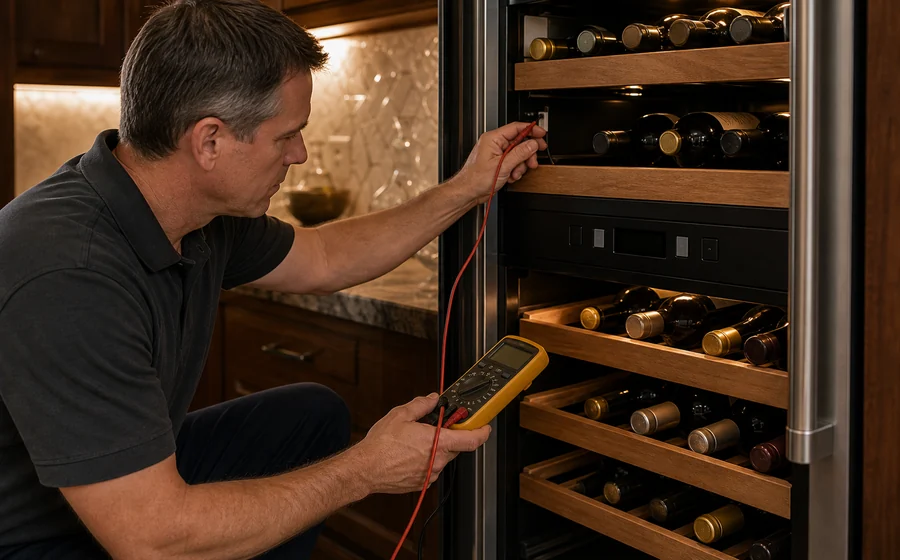
Garages and summer kitchens run hot and damp
Plenty of Jax Beach homes put the wine unit in a garage, a summer kitchen, or a butler pantry off the main room — spaces that swing 15 to 20 degrees warmer and far more humid than a climate-controlled kitchen. The compressor runs long to keep up, the glass door collects condensation, and a marginal door seal turns into a real one. Sometimes the fix is a seal and a service; sometimes it is improving airflow around the cabinet so the condenser can breathe.
Salt air ages the seals faster
Door gaskets near the ocean stiffen in three to four seasons, and a wine unit's seal carries extra duty because it is fighting humidity, not just holding cold. A hardened gasket lets damp air slip in, which feeds icing and condensation both. We check the seal on every wine call before we chase anything deeper — it is cheap, common, and easy to miss.
If the trouble is a full-size box rather than the wine cabinet, the refrigerator repair page runs the matching diagnosis. Built-in wine column flush in the cabinetry? The BI-series page covers integrated access, and we run every street in the 32250 coverage area.
What we actually do
What a Wine-Unit Visit Includes
A wine cabinet is judged on steadiness, not raw cold, so the visit is built around proving each zone holds the 45-to-55°F storage band. It runs in cost order, cheap and common parts first.
- Read each zone against our own probe. On a dual-zone unit we check both setpoints independently — a single drifted thermistor is the most common find and the cheapest to fix.
- Inspect the door seal and the glass. A hardened gasket and a fogging UV-rated door point at humidity load before we chase anything in the refrigeration circuit.
- Check the evaporator for icing. Frost on the back coil flags a stuck sensor or a defrost fault that is over-cooling and risking the bottles.
- Verify the condenser and clearances. In a hot garage or butler pantry, a starved condenser drives long runtimes and door sweat — sometimes the fix is airflow, not a part.
- Prove refrigerant last. Only if airflow, sensors, and seals all clear do we pull pressures, since sealed-system work is the one lane that changes the repair-or-replace math.
You get a written number before any panel comes off, and on an integrated column the access plan is part of that quote. The cost guide lays out how each wine lane is built, and a seven-day booking slot is a tap away.
The parts bin
Parts We Replace on a Sub-Zero Wine Unit
Wine-storage repairs cluster around a short list of parts, and most are targeted swaps rather than whole-unit jobs. Here is what comes off the truck most for 424, 427, BW-30, and IW-series units in 32250.
| Part | Symptom it causes | Why it fails in 32250 |
|---|---|---|
| Zone thermistor (sensor) | One zone holds, the other drifts off band | Sensor reading wanders with age; controller chases it |
| Door gasket / UV-rated seal | Sweating glass, edge condensation, icing | Salt and humidity harden the seal in three to four seasons |
| Evaporator fan | Both zones drift warm together | Long runtimes in a hot garage or summer-kitchen install |
| Condensate / anti-condensation parts | Water pooling, persistent door fog | Coastal humidity overwhelms the system in unconditioned spots |
| Control board | Both zones erratic, display faults | Restoration surge after a lightning-belt outage |
The storage target is a steady 45-to-55°F per zone; more than a couple of degrees off after stabilization means a part, usually a thermistor. Built-in column flush in the cabinetry? The BI-series page covers the integrated access these units share.
Case Note: 1st Street South, the Lopsided Zones
Educational diagnostic scenario — a composite of common Jax Beach calls, not a customer review
A 427 dual-zone unit in a 1st Street South home: the lower zone held a steady 55°F while the upper zone had crept to 62°F over a few weeks. No icing, no leak, both fans turning. Reading each zone against our own probe showed the upper thermistor reporting several degrees cold — so the controller was under-cooling that side on purpose.
One thermistor, recalibrated control, and a door seal we replaced while we were in there. Both zones settled into spec within hours. The ticket sat in the mid-hundreds. The takeaway: a lopsided dual-zone unit is a sensor problem far more often than a refrigeration problem.
Good questions
Wine Storage Questions From the Beach
One zone of my dual-zone wine fridge holds temp and the other drifts — what is that?
That split is the signature of a drifting thermistor. Dual-zone Sub-Zero wine units run a temperature sensor per zone, and as one ages its reading wanders, so the controller holds the wrong setpoint on just that side. The cabinet is fine; the sensor is lying to it. We verify each zone against our own gear and swap the drifted thermistor — a targeted fix, not a whole-unit job.
My wine unit is icing up at the back — should I be worried about the bottles?
Icing on the evaporator means the unit is overcooling or not defrosting, and both put your bottles at risk of dropping below the 45-to-55°F range good storage wants. The usual causes are a stuck sensor, a defrost fault, or a door seal letting humid air in. We clear the ice, find why it formed, and get the zone holding steady before it stresses corks and labels.
Why does my garage or butler-pantry wine fridge sweat and struggle in summer?
Heat and humidity load. A wine unit tucked in a Jax Beach garage or summer kitchen fights ambient temperatures and moisture the spec sheet never assumed. The compressor runs long, the door sweats, and condensation collects around the glass. We check the door seal, the condenser, and the install clearances — sometimes the fix is service, sometimes it is relocating airflow around the cabinet.
Is it worth repairing an older 424 or 427 wine unit, or should I replace it?
Usually worth it. A thermistor, fan, or door seal on a 424G or 427 runs a few hundred dollars against a four-figure replacement plus the cabinetry to fit a new box. These units were built to last, and a sealed-system repair only changes the math when refrigerant is actually involved. We give you both numbers and the honest read on the cabinet before you decide.
Do you work on the newer integrated and undercounter wine units too?
Yes — the BW-30, IW-series, and undercounter wine columns are all in our wheelhouse. The integrated models add install complexity because they sit flush in cabinetry, so panel and hinge access takes care. The failures rhyme with the classics, though: thermistor drift, evaporator icing, UV-door seal wear, and condensate problems in our humid coastal climate.
What temperature should each zone of a Sub-Zero wine fridge actually hold?
Good storage lives in a 45-to-55°F band, and a dual-zone unit lets you split it — typically a cooler zone near 50°F for whites and sparkling and a warmer zone near 55°F for reds. Humidity matters too; wine cabinets are built to hold higher humidity than a regular fridge to protect corks. If a zone wanders more than a couple of degrees off its setpoint after stabilizing, a drifted thermistor is the usual reason.
My wine unit hums or vibrates more than it used to — is that a problem?
A new buzz or rattle is worth a look before it becomes a failure. It usually traces to an aging evaporator or condenser fan, a loose shelf or bottle rack resonating, or a compressor working harder against a hot install spot. We isolate the source, check the fan bearings and mounts, and confirm the unit is not over-running. Caught early it is a contained fix; ignored, a failing fan lets a zone drift warm.
Can I move my wine cabinet out of the hot garage to make it last longer?
Relocating to a climate-controlled space is one of the best things you can do for a beach wine unit. Garages and summer kitchens swing 15 to 20 degrees warmer and far more humid than the spec sheet assumes, which forces long compressor runs and feeds door sweat. If moving it is not practical, improving airflow around the cabinet and keeping the condenser clean buys most of the same benefit.